
What If We’re Getting Mental Health All Wrong?
We live in a culture obsessed with optimization. From step counts to sleep cycles, we monitor everything—logging macros, syncing devices, and spending billions on wearables and supplements. Yet brainwaves—the electrical patterns responsible for regulating mood, sleep, focus, and emotional processing—are still overlooked. These patterns are observable, measurable, and trainable—yet they remain absent from most mental health evaluations

Facts & Figures
More than 1 in 5 U.S. teens report persistent sadness or hopelessness (CDC, 2023). Suicide remains a leading cause of death among adolescents—and the leading cause for men aged 15–44 (SPRC, 2020). Meanwhile, parents aren't just paying emotionally—they’re paying financially, sometimes up to $120,000 annually searching for solutions (NATSAP, 2023).
And for physical enhancement? Americans spent $63 billion on cosmetics, $7 billion on orthodontics, and $50 billion on weight loss and wellness tools (Statista, 2024; ADA, 2024; MarketData LLC, 2024).
And families also spend over $40 billion per year on youth sports—with the average parent investing $1,016 to $3,000+ per child annually on activities like travel baseball, gymnastics, and dance (Aspen Institute, 2025; Project Play, 2024).
However..
When it comes to mental clarity, emotional regulation, sleep, and focus—we’re still guessing. Despite all this spending, the brain itself remains overlooked. That’s not just a missed opportunity—it’s a moral contradiction.
We measure heart rate, cholesterol, glucose, and blood pressure. We wouldn’t cast a broken bone without an X-ray—or tune a car without looking under the hood. So why, in mental health care, are we prescribing medications, constructing therapeutic plans, or making referrals—without assessing how the brain is functioning with a brainwave map (qEEG)?
This isn’t about doing more—it’s about doing what actually works. It’s about revealing what’s really going on in the brain, removing the guesswork, and lifting years—sometimes decades—of hidden shame or self-blame. Don’t we all deserve that level of clarity? Because when you can finally see the truth, you’re equipped to take the right next step.
Brainwave dysregulation contributes to symptoms people experience every day—anxiety, emotional reactivity, focus issues, and sleeplessness (Thibault et al., 2018; Arns et al., 2009). Yet when these symptoms surface, families are often left coping. They cycle through multiple forms of care—EMDR, brainspotting, CBT, talk therapy—or rely on medication to manage the symptoms. It becomes the default path forward.
Why? Because the professionals they trust either weren’t aware that mapping the brain could provide answers—or they knew, but didn’t bring it up.
Sometimes it’s because they feel the weight of what that family has already been through—parents who’ve emptied savings, gone into debt, or cashed out retirement accounts trying to help a struggling teen or young adult. Sometimes it’s concern about offering something that feels outside their scope of care. And often, it’s simply a confidence gap—they’re unsure how to explain a qEEG brain map in a way that helps clients understand the value of seeing what’s actually happening inside the brain.
So they hesitate. They stay silent. But silence doesn’t serve the client. It keeps them guessing. It delays insight. And it quietly reinforces the idea that this struggle is something they just have to live with.
When something isn’t offered as an option, clients may never realize it exists. Worse, they may internalize the idea that there is no better option—that their current experience is “as good as it gets.”
That raises a deeper ethical question: In a world where brainwave dysregulation is both measurable and addressable, is it responsible—or even justifiable—to keep guessing?
People aren’t just struggling with anxiety, impulsivity, or sleepless nights. They’re struggling with the fact that no one can tell them why. And most of the professionals they turn to don’t realize there’s a way to find out—despite growing access to non-invasive, affordable neurotechnology (Thibault & Raz, 2017; ISNR, 2023).
A 2023 survey by the International Society for Neurofeedback and Research (ISNR) found that fewer than 10% of mental health providers regularly use brainwave measurement tools in practice. Many remain unaware that qEEG assessments are non-invasive, cost-effective, clinically validated, and supported by decades of research (ISNR, 2023; Arns et al., 2014).
That needs to change—urgently.
SYMMETRY Neuro-Pathway Training's Mission
For 15 years, SYMMETRY Neuro-Pathway Training has been on a mission to close the gap between what families are experiencing—and what professionals are actually measuring. The company was born from the journey of a mother—Dianne Kosto—who was desperately searching for answers to help her son, a child struggling with explosive impulsivity and nowhere left to turn. What she learned changed everything: brainwave patterns could be measured, trained, and improved.
She became certified, applied it with her own son—and saw the impact firsthand. Not just for him, but for every client who came through the door.
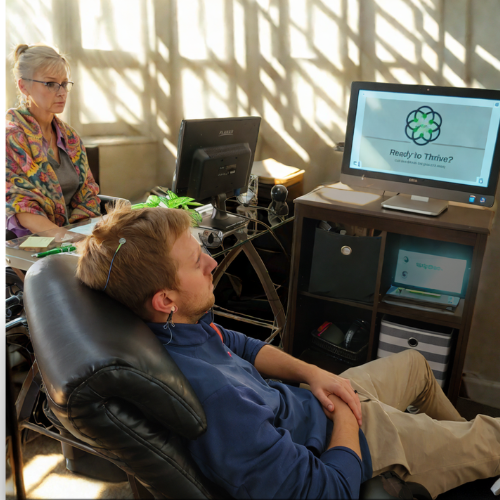
It lit a fire. Yes, she was thrilled to see results. But she was also angry. For over a decade, she had searched for answers—endlessly trying to help her son—and not once had anyone mentioned that measuring brainwaves or using neurofeedback was even an option.
From that moment on, her mission became clear: to make brainwave regulation accessible to more families, more providers, more people. To ensure that parents like her—and anyone who’s been struggling without answers—could finally make sense of what’s happening in the brain and be offered a real, evidence-based path forward.
The Problem
Today, the problem isn’t that we lack options. It’s that we have too many—and too few professionals who understand how to guide clients toward what actually works, especially when it comes to brain function and mental wellness.
In 2023 alone, Americans spent $1.8 billion on wearable tech—tracking everything from sleep and stress to glucose, HRV, and even posture (IBISWorld, 2024; Harvard Health Publishing, 2023). More than 25 million people are using biometric tools to optimize their health. But the one thing that can objectively show what’s happening inside the brain—qEEG brain mapping—is still underutilized, often overlooked, and rarely discussed with the clients who need it most.
Snapshot: What We Spend vs. What We Measure
$1,016 spent per child on a primary youth sport—up 46% since 2019 (Aspen Institute, 2025)
$40 billion+ annually on U.S. youth sports overall
$63 billion on cosmetics, $7 billion on orthodontics, $50 billion on weight-loss/wellness tech
$1.8 billion spent on wearable tech in 2023; over 25 million Americans use biometric tracking
Fewer than 10% of providers incorporate qEEG brain mapping in practice
If you’re a therapist, coach, MD, or school counselor, you may not realize that a qEEG brain map can offer objective, measurable insight into patterns linked to mood instability, anxiety, attention challenges, and emotional regulation. You don’t have to guess. You can refer. You can collaborate. And you can help clients make more informed decisions about their path forward—grounded in data, not just symptoms.
Case Snapshot: From Guesswork to Clarity
Take the case of a 15-year-old student who was constantly being labeled “defiant” or “distracted.” His parents had tried everything—therapy, medication, tutoring, school accommodations—but nothing seemed to stick. A qEEG brain map finally revealed that his brain was stuck in a state of low alertness in areas tied to attention and self-regulation. With targeted brainwave regulation, his sleep improved, his mood stabilized, and for the first time, he was able to focus and succeed in school without constant intervention. That one brain map gave everyone involved in his care—from parents to providers—the clarity they needed to make better choices.

A second case: a 47-year-old executive facing burnout, memory lapses, and persistent sleep issues. She had tried supplements, yoga, therapy, even hormone testing—until a qEEG brain map revealed that her brain was stuck in overdrive—constantly wired, even when she felt exhausted. With targeted brainwave regulation using neurofeedback, her emotional volatility and cognitive fog lifted—allowing her to return to peak performance.
And it’s not just teens and executives. Working parents, caregivers, college students, and even clinicians are struggling with invisible cognitive and emotional fatigue. Many are living in chronic stress patterns they can’t name—but that show up clearly on a qEEG brain map. What would it look like to give them clarity instead of just coping skills?
The real mental health crisis? It’s not just the symptoms—it’s the guesswork.
We believe ethical care includes measuring what we can—so families can stop spinning in circles and finally start making measurable progress. When brainwave dysregulation is contributing to what your clients are facing, failing to offer a qEEG brain map isn’t just a missed opportunity—it’s denying them the clarity they deserve.
In a world flooded with wellness options, families are overloaded with choices. They turn to the professionals they trust for direction. So if you’re not measuring brainwaves, how are you helping them choose the best path forward with confidence?
So here’s our ask:
If you’re a provider, ask yourself: Why isn’t qEEG brain mapping part of your assessment strategy? And if you’re a parent or individual who’s never been offered this option, ask your provider: Why aren’t you using qEEG brain mapping to better understand what’s happening in my brain?
We’ve normalized asking for labs, imaging, and prescriptions. It’s time we also normalize asking for a qEEG brain map—because understanding brain function should be just as routine.
The tools are available. The data is real. And the ethics are clear. It’s time to stop guessing—and start measuring what matters.
🧠 FAQ: Common Questions About Brain Mapping
What is qEEG brain mapping?
A non-invasive, clinically validated scan using sensors on the scalp to objectively measure brainwave activity. Think of it as a “brain EKG.”
SOURCES
contact
social
SYMMETRY Neuro-Pathway Training © 2025