
[#002] Relief Doesn’t Equal Resilience
Why Getting Better Feels Harder Than It Should
Getting sick is normal.
What’s becoming less common is fully recovering.
When people get sick, or don’t quite bounce back, it’s usually not because they aren’t doing enough to support their body.
The brain decides when protective systems turn on — and when they turn off.
It’s because the body struggles to coordinate a response and then shut it down.
When I say “coordinate,” I’m talking about the brain.
The brain decides when protective systems turn on — and just as importantly, when they’re able to turn back off.
That ability — shifting out of protection and into recovery — is what allows people to actually feel better again.
Watch the Video: Relief Doesn’t Equal Resilience — Brainwave Regulation Explained
Inflammation Isn’t the Problem — Stuck Systems Are
Inflammation is a good example of the body responding to a signal from the brain.
It’s supposed to rise when you’re injured or fighting an infection.
Think:
Fever.
Swelling.
Soreness.
Those are signs the immune system is doing its job. Inflammation isn’t the problem. The problem is when it doesn’t fully resolve after the threat has passed.
"Stress hormones are useful in short bursts. Damaging when they stay elevated."
When these systems shut off the way they’re designed to, recovery follows.
- Sleep becomes restorative — not just long, but actually helpful
- Energy returns
- Thinking feels clearer

What Brainwave Data Reveals About Recovery Post‑Pandemic
When they don’t, you see what’s become increasingly common since the pandemic:
- Lingering brain fog
- Sleep that never feels restorative
- Low energy
- A nervous system stuck in “on.”
- It’s easy to blame the virus.
But much of this comes down to whether the brain can regulate — or whether it stays stuck in overdrive long after the threat is gone.
Why the Brain Still Gets Left Out of the Recovery Conversation
That connection is impossible for me to ignore.
Because right now, we’re surrounded by more wellness tools than ever.
Red light therapy.

Hyperbaric oxygen.
IV therapy.
Cold exposure.
And much of it helps.
But here’s what rarely gets addressed:
Every one of these interventions still depends on the brain to do its job.
"The brain is the switchboard. It determines whether the body powers down into repair — or stays locked in stress."
When the brain is dysregulated,
even the best tools have to work harder.
And results become less predictable.
Why Resilience Is the New Focus in Wellness and Performance
Since the pandemic, people are paying attention to resilience in a different way. Not just recovery — but prevention.
How well the body holds up under stress. How quickly it responds. How easily it settles back to baseline. You can see that shift everywhere.
In the explosion of non-traditional wellness options. In the money being invested in recovery and performance tools. In the desire to feel better, think sharper, recover faster, and perform at a higher level before illness hits.
What Gets Missed: Measuring Brainwave Regulation
What often gets missed is that most of these approaches don’t actually look at how the brain is functioning.
They support the body, but they don’t measure brainwave patterns, which means they can’t show whether the nervous system is shifting out of stress and into regulation. That’s where many conversations around recovery miss the mark.
We assume things are better because symptoms went away — or because enough time passes.
"Regulation isn’t passive. It’s an active process."
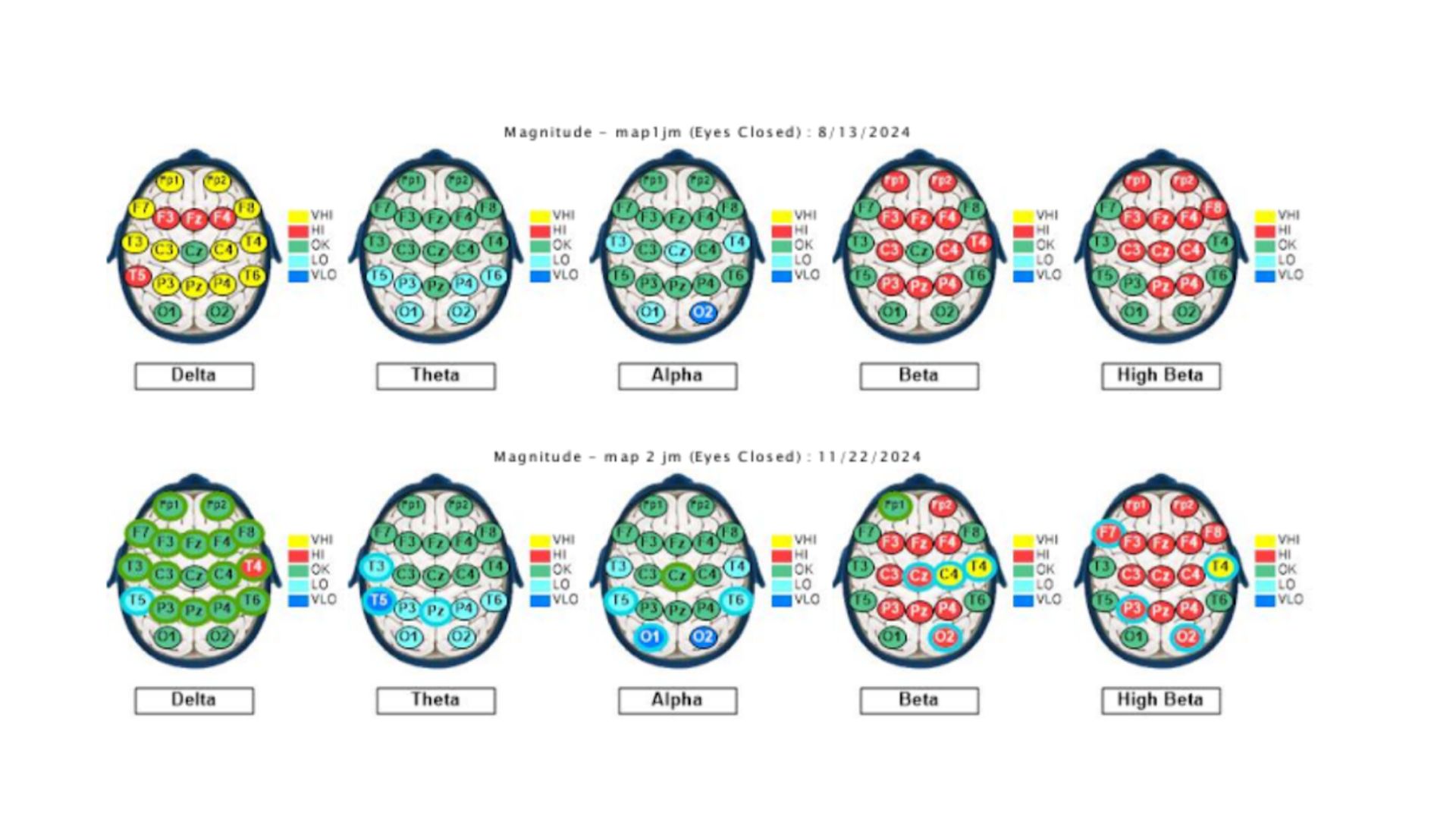
Before & After: Brainwave Patterns Show Real Change
When you can look at brainwave patterns over time, you can see whether the brain is adapting — or still working overtime.
This is an example of what that can look like.
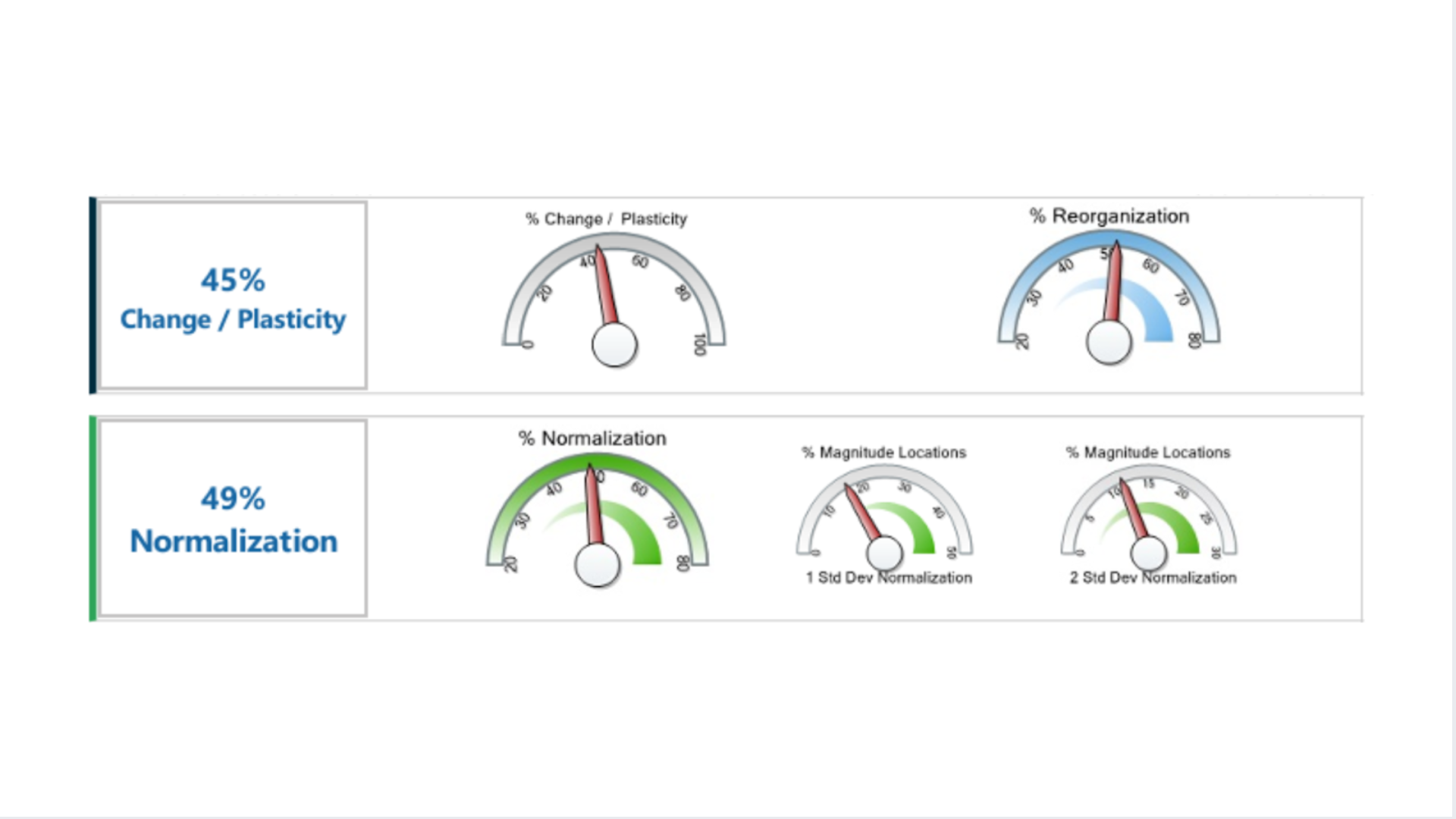
It’s not a diagnosis.
It’s not a label.
It’s simply a before-and-after snapshot of how the brain was organizing itself — and how that organization shifted with targeted training focused on regulation.
What matters here isn’t perfection. It’s the brain’s ability to shift.
To reorganize.
To move out of constant protection mode and back toward balance.
Resilience Depends on the Brain’s Ability to Shift
That capacity underlies resilience. It influences how the body responds to stress, how efficiently it recovers, and how easily it returns to baseline after illness or disruption.
If you aren’t looking at brainwaves, you’re guessing about resilience, recovery, and prevention.
For decades, medicine and wellness have circled a quiet truth:
Suppressing symptoms isn’t the same as restoring resilience.
That’s where brain health comes back into the picture —
because it shapes how the nervous system coordinates response and recovery.
When the brain can move efficiently between states, everything downstream works better. When it can’t, the body compensates. And compensation is exhausting.
Why Brain Function Can’t Be Treated as Optional
Medicine and innovation have given us more ways than ever to support the body.
Most of them help — at least for a while.

What’s striking is how rarely we pause to look at how the brain is organizing those responses in the first place.
And that matters — especially now.
"Stressors don’t arrive one at a time anymore. And the brain bears the weight."
Respiratory viruses like influenza, RSV, and COVID continue to circulate — often overlapping. That means many people aren’t dealing with a single stressor.
They get sick.
Try to recover.
Then get hit again before they’ve fully reset.
For some, they never felt fully well after the last illness
before the next one arrived.
In that state, the brain is under constant demand.
How well the brain manages that load influences how resilient the body’s responses ultimately are.
Why Brainwave Data Should Be Part of Every Resilience Protocol
Which is why, if we want better prevention, smoother recovery, and more sustainable resilience, we can’t keep treating brain function as optional or secondary.
Wellness, longevity, and recovery can’t be addressed in compartments. Brainwaves influence how the body responds to stress, illness, and recovery.
When brain function isn’t considered, we end up guessing. That’s not the same as knowing.
Book a Discovery Call with SYMMETRY Neuro‑PT
If you’re a clinic owner or wellness professional who wants to explore how brainwave regulation can be integrated into your practice:
--> Schedule your discovery call here
contact
social
SYMMETRY Neuro-Pathway Training © 2025